What Is a JDM Watch? The Collector's Guide to Japanese Domestic Market Timepieces
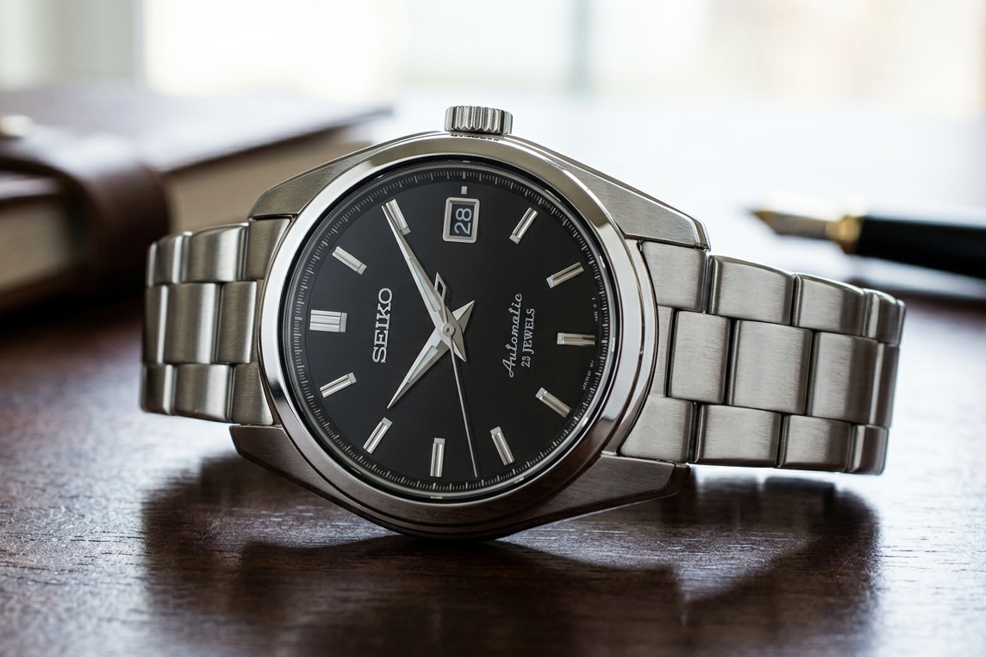
There's a term that comes up constantly in watch collecting circles — "JDM" — and it means something different here than it does in car culture, even though the acronym is borrowed directly from it. If you've been browsing watch forums, auction listings from Japan, or secondhand platforms, you've seen the prefix. You've probably wondered, at some point, whether it actually matters or whether it's just collector jargon for the sake of sounding exclusive.
It matters. Here's a proper explanation of what JDM means in watches, why certain models end up designated for Japan's home market, and why collectors outside Japan spend considerable effort to track them down.
What Does JDM Mean?
JDM stands for Japanese Domestic Market. The term originated in the automotive world, where it described vehicles produced in Japan and sold specifically within Japan — often with different engine specs, safety equipment, or features from export versions. The watch community adopted the same logic.
A JDM watch is a timepiece produced by a Japanese manufacturer — Seiko, Citizen, Casio, Orient, and others — that is intended exclusively for sale within Japan. These models are not officially distributed through international dealer networks. They won't appear on a Seiko US retailer's shelves, they won't be listed on Citizen's European website, and they frequently carry reference numbers that differ from their export counterparts.
One important distinction worth clarifying early: JDM does not automatically mean "Made in Japan." The two are often conflated. Many JDM Seikos are indeed manufactured in Japan — and this is genuinely noted on the dial or caseback — but JDM is a distribution designation, not a production one. A watch can technically carry a JDM designation while having components assembled elsewhere. That said, in practice, the overlap is significant; Japanese manufacturers tend to reserve their domestically produced pieces for their home market.
Why Do Japanese Brands Create JDM-Exclusive Models?
The answer is partly commercial, partly cultural, and partly a reflection of how Japanese consumers approach product quality.
Japanese consumers are, broadly speaking, extremely demanding. The domestic market expects precision, high-quality finishing, and thoughtful design. Seiko, for instance, has always treated its home market as the primary audience for its best work. When Seiko produces a watch with a sapphire crystal, a harder-finished bracelet, or a more refined movement variant, that watch often stays in Japan. The international market might receive a version with Hardlex mineral crystal and a simplified bracelet — functional, but not the same.
This phenomenon is not exclusive to watches. Japanese electronics, cameras, and automobiles have operated similarly for decades. The home market gets the better-specified product; the export market gets what that market will sustain.
There's also a practical element: certain designs or complications are simply more relevant to Japanese consumers. The Kanji day wheel — a day-of-the-week display using Japanese characters — has no appeal outside Japan. Some JDM models carry specific cultural references, dial colorways inspired by regional aesthetics, or limited edition collaborations with Japanese institutions, sports teams, and cultural events that have no international context.
Brands also conduct their own market analysis. If a particular watch style or complication is not expected to perform commercially in the US or European market, it stays domestic. Not every JDM watch is a hidden gem; some are straightforwardly niche, designed for a specific Japanese buyer demographic that doesn't exist elsewhere at scale.
The Key Brands and Their JDM Lines
Seiko
Seiko is the brand most associated with JDM collecting, and for good reason. The depth of Seiko's domestic catalogue is remarkable. While the brand's export lineup is extensive, it represents a fraction of what's available in Japan.
The SARB series is one of the most cited examples. Seiko introduced the SARB collection exclusively for the Japanese market in 2006, positioning it above the 5 Sport line as a more refined, dressy automatic at an accessible price. The SARB033 — a 38mm dress watch powered by the 6R15 automatic movement, offered with a clean black dial, applied indices, and a bracelet that drew clear inspiration from Grand Seiko — became one of the most sought-after JDM references ever produced. It was introduced in 2008 and discontinued in 2018, and secondary market prices have roughly doubled since then.
The SARB065, nicknamed the "Cocktail Time" for its sunburst blue dial that changes character under different lighting, launched as a JDM model in 2010. Seiko later introduced an international "Presage" version in 2017, essentially acknowledging the global demand that had existed for years in the grey market.
The Prospex line also maintains robust JDM-exclusive references, typically with better dial variants, sapphire crystals, and stronger movement specs than their export equivalents. The Marinemaster series has historically been one of the more compelling JDM categories.
Citizen
Citizen's JDM offerings are less discussed internationally but equally interesting. The Promaster and Attesa lines contain Japan-exclusive references with specifications that surpass their export counterparts. Citizen's "The Citizen" series — which centres on their proprietary ±5 seconds per year Chronomaster quartz movement — is effectively a JDM-only product line at the higher end, representing some of the most precise consumer quartz movements ever produced.
The Exceed series, a JDM favourite for dress watches, features perpetual calendars and sapphire crystals at prices that would be considered exceptional value internationally, if they were available internationally.
Casio
Casio's JDM strategy leans heavily on collaboration and limited edition releases. G-Shock collectors outside Japan are well aware that some of the most interesting colourways, special editions, and collaboration models — with brands, artists, and cultural institutions — are produced exclusively for the Japanese market and released with Japanese market reference numbers (typically carrying a JR suffix, denoting Japan Retail). The MT-G and MR-G series within G-Shock, representing the line's flagship tier, also maintain JDM references with materials and finishes that differ from export versions.
Orient
Orient's Revival and Star lines include Japan-exclusive references that offer genuinely compelling specifications. The Orient Star semi-skeleton and power reserve models in JDM configuration occasionally feature finishing details absent from the international catalogue.
JDM and Japanese Collector Culture
Understanding JDM collecting means understanding something about how Japanese consumers relate to their manufactured goods. There is a concept — loosely translated as monozukuri — the art of making things — that runs through Japanese manufacturing culture. The domestic market is, in many respects, where that philosophy is most fully expressed. Watches made for Japan are made with the assumption that the buyer will notice every detail: the finishing on the movement, the weight of the bracelet clasp, the uniformity of the dial surface.
Japanese collectors are also highly attuned to condition. The secondhand market in Japan — through auction houses, used goods platforms like Mercari Japan and Yahoo! Auctions Japan, and specialist dealers in areas like Nakano Broadway in Tokyo — maintains standards of care that are genuinely unusual by international comparison. A watch described as "used" in a Japanese auction listing is often in what Western sellers would call excellent or near-mint condition.
This creates an interesting dynamic: Japan produces excellent watches, keeps the best of them for its home market, and then tends to preserve those watches in extraordinary condition when they eventually enter the secondhand market.
Why International Collectors Chase JDM Watches
The appeal is straightforward once you understand the landscape. Better specifications, unique references, and the condition standard of secondhand Japanese inventory combine into a compelling case.
For many collectors, the JDM grey market represents something that's increasingly rare in watch collecting: genuine value. A Seiko SARB033 with sapphire crystal, an in-house movement, and Grand Seiko-adjacent finishing, bought from Japan on the secondhand market, represents a different proposition from most watches at an equivalent price point in Western retail.
There's also the aspect of differentiation. In a hobby where the same popular references appear everywhere, owning a watch that was never sold in your country — that required deliberate effort to source — carries a particular satisfaction.
For vintage collectors specifically, Japan is one of the most reliable sources of well-preserved old stock. The combination of a strong domestic market and careful preservation means vintage JDM timepieces from the 1970s and 1980s regularly surface in condition that would be exceptional anywhere else.
Common Mistakes Collectors Make with JDM Watches
Assuming JDM means Made in Japan. As covered earlier, these are distinct designations. Conflating them leads to misunderstandings and occasionally overpaying for watches based on incorrect assumptions.
Ignoring import duties. Purchasing a watch from Japan involves import duties and taxes in the destination country. These costs are real, sometimes significant, and should be calculated before purchase, not after arrival.
Buying without authentication. The popularity of JDM references like the SARB033 and certain Grand Seiko references has created a secondary market for fakes, particularly on unvetted platforms. Buying from trusted sources matters.
Expecting manufacturer warranty support. JDM watches purchased outside Japan are generally not covered by international warranty programmes. Service needs to be planned accordingly, either through Seiko's international service centres (which will service JDM pieces but may not honour warranty terms) or through independent watchmakers with relevant expertise.
Over-romanticising the designation. Not every JDM watch is special by virtue of being JDM. The designation indicates intended distribution, not guaranteed quality. Research the specific reference as you would any watch purchase.
How to Source JDM Watches from Outside Japan
This is where the practical difficulty lives. Unless you're physically in Japan with access to retail stores and auction previews, sourcing JDM watches requires navigating a market that operates in Japanese, on Japanese platforms, with Japanese payment infrastructure.
Several specialist retailers based in Japan operate English-language storefronts for new JDM inventory. For the secondhand and vintage market, the options narrow further. Yahoo! Auctions Japan and Mercari Japan are the dominant consumer platforms, but operating on them from outside Japan requires a proxy service or a local contact.
Many collectors outside Japan struggle to access domestic listings and dealer networks. Services like Nivern help bridge that gap by sourcing watches directly from Japanese marketplaces and trusted local dealers, handling authentication, condition verification, and international shipping.
For higher-value vintage pieces, specialist sourcing makes more sense than attempting to navigate the auction platforms independently. The risk of condition misrepresentation or authentication issues, absent the ability to inspect in person, is non-trivial.
Is a JDM Watch Right for You?
If you're considering your first JDM purchase, the calculus is fairly simple.
You're a good candidate if: you've already developed familiarity with Japanese watch brands, you're buying for wearing rather than as a purely financial instrument, and you're comfortable with the service pathway for your purchase (independent watchmaker or Seiko/Citizen service centres).
Proceed with more caution if: this would be a significant financial commitment without prior experience in the grey market, you're heavily reliant on manufacturer warranty coverage, or you haven't researched the specific reference in depth.
The JDM market rewards collectors who do their homework. The specifications are often genuinely better. The secondhand inventory from Japan is often in better condition than equivalent pieces sold in Western markets. The references are frequently more interesting. But these advantages accrue to buyers who understand what they're looking at.
Conclusion
JDM watches occupy a particular and legitimate niche in watch collecting — not as a marketing category, but as a genuine reflection of how Japanese manufacturers have historically served their domestic market. The best of Seiko, Citizen, Casio, and Orient has often stayed in Japan, offered to a domestic consumer base that expects, and receives, a higher specification product.
For collectors outside Japan, this represents both a challenge and an opportunity. The challenge is access. The opportunity is that JDM grey market pricing, particularly for secondhand pieces, frequently offers better value than equivalent quality from international distribution — if you know what you're looking for and where to find it.
A 38mm automatic dress watch with sapphire crystal, an in-house movement, and production standards that prompted collectors to nickname it the "Baby Grand Seiko" — that's not a niche curiosity. That's just a good watch that happened to be sold only in Japan.
FAQ
What does JDM mean in watches? JDM stands for Japanese Domestic Market. It refers to watches produced by Japanese manufacturers that are designated exclusively for sale within Japan and are not part of the brand's official international distribution.
Is JDM the same as Made in Japan? No. JDM is a distribution designation, not a production one. Many JDM watches are manufactured in Japan, but not all of them are, and some Made in Japan watches are sold internationally.
Are JDM watches better quality than international versions? Often, yes — in terms of specifications. JDM versions of watches from brands like Seiko and Citizen frequently include sapphire crystals, better movement variants, or higher-quality bracelets compared to their export equivalents. This is not universal, however, and depends entirely on the specific reference.
Can I buy a JDM watch outside Japan? Yes. JDM watches are not subject to export restrictions. They enter the grey market through specialist retailers, auction platforms, and sourcing services. They are legal to purchase internationally.
Will my JDM watch have warranty coverage? Generally no, or not under standard international warranty terms. JDM watches are not part of a brand's international distribution, so international warranty programmes typically do not apply. Seiko and Citizen service centres will generally still service JDM pieces, but warranty terms should be confirmed before purchase.
What are some of the most collectible JDM watch references? The Seiko SARB033, SARB035, and SARB065 are among the most discussed JDM references. The Seiko Marinemaster series in JDM configuration, certain Grand Seiko references, and Citizen's "The Citizen" Chronomaster line are also notable. In the Casio G-Shock world, MT-G and MR-G Japanese-exclusive variants have strong collector followings.
What's the best way to buy a JDM watch from abroad? Options include English-language specialist retailers based in Japan (for new inventory), grey market platforms like Chrono24 (where individual sellers often list JDM pieces), and dedicated sourcing services like Nivern that handle the process of identifying, authenticating, and shipping JDM watches directly from Japan.
Sources & References
- Teddy Baldassarre — "Seiko SARB033: Why This JDM Watch Has A Cult Following": https://teddybaldassarre.com/blogs/watches/seiko-sarb033
- Worn & Wound — "Seiko Says Goodbye to Four Iconic Watches": https://wornandwound.com/seiko-says-goodbye-four-iconic-watches-sarb017-sarb033-sarb035-sbdx001/
- Time and Tide Watches — "Are JDM Seikos Better Than Normal Seiko Watches?": https://timeandtidewatches.com/are-jdm-seikos-better/
- WatchUSeek Forums — "SARB033/35 Revisited": https://www.watchuseek.com/threads/seiko-sarb033-35-revisited.5308936/
- Chrono24 Magazine — "Exploring the Finest Seiko JDM Watches": https://www.chrono24.com/magazine/hidden-treasures-exploring-the-finest-seiko-jdm-watches-you-need-to-know-p_116131/
- Everest Bands — "JDM Watches: Everything You Need to Know": https://www.everestbands.com/blogs/bezel-barrel/jdm-watches-everything-you-need-to-know
- Chrono24 — Seiko SARB033 reference page (case specifications): https://www.chrono24.com/seiko/ref-sarb033.htm
- WatchUSeek Forums — "JDM vs Non-JDM": https://www.watchuseek.com/threads/jdm-vs-non-jdm.5281734/
- Seiko official website (Japan): https://www.seiko.co.jp
- Citizen official website (Japan): https://citizen.jp