Why Vintage Japanese Watches Are Rising in Value
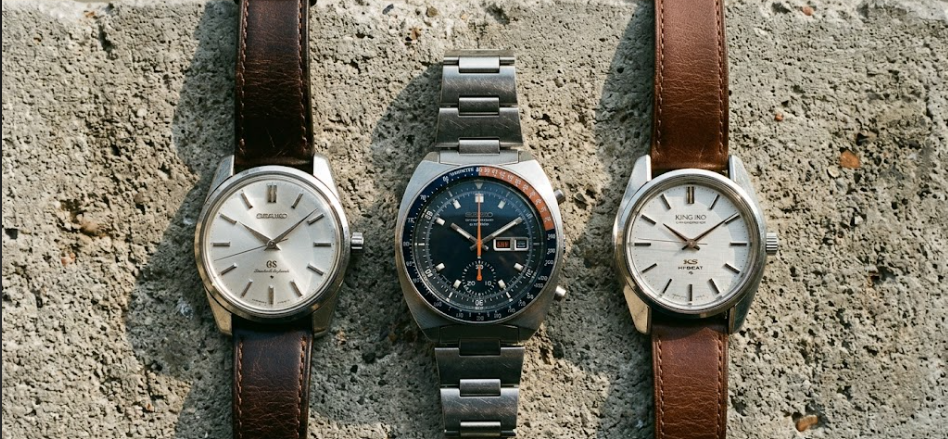
For most of the past half-century, vintage Japanese watches occupied a peculiar position in the market. Collectors who knew them — really knew them — understood what was there: serious horology, in-house movements, case finishing that reflected genuine craft, and a manufacturing philosophy that was, in certain respects, more rigorous than what was happening concurrently in Switzerland. Everyone else looked at the Seiko or Citizen name on the dial and assumed budget.
That assumption is correcting itself, and the correction is gathering pace.
The story of why vintage Japanese watches are rising in value is not a simple one about hype or trend-chasing. It involves a convergence of factors: growing institutional recognition at the highest levels of the auction market, the structural scarcity of the best examples now locked into Japan's secondhand ecosystem, genuine horological credentials that were always present but long underpriced, and a new generation of collectors who have done their research and are not impressed by brand prestige alone.
What "Rising in Value" Actually Looks Like
Before discussing the reasons, the data deserves attention because it grounds the conversation.
WatchCharts, which tracks secondary market prices across thousands of references, shows that several Seiko 6139 Speedtimer variants have appreciated substantially over the past five years — substantially enough to outperform the broader Seiko index. The 6139-7101 "Helmet" chronograph, for instance, recorded a 60.3% price increase over a single twelve-month tracking period, against a broader Seiko index figure of 9.5% over the same span. The 6139-7100 is up 52.4% over five years, again outperforming the brand average. Even across the Seiko chronograph index more broadly, the WatchCharts data shows a basket of 30 tracked references rising 27.5% in one year — at a time when the overall watch market, which experienced its own speculative run during 2021–2022, was broadly correcting.
At the top of the market, the auction evidence is even more direct. Phillips Geneva — arguably the most influential watch auction house in the world for establishing what the collector community considers canonical — has spent the last several years deliberately introducing vintage Grand Seiko to its catalogue, beginning with the May 2021 Geneva Watch Auction XIII. Three vintage Grand Seiko lots placed at Phillips Geneva between 2021 and 2022 achieved results that surprised even attentive market observers:
- A 61GS VFA (ref. 6186-8000) sold for CHF 44,100 in May 2021
- A 44GS (ref. 4420-9000) sold for CHF 59,220 in November 2021
- A first Grand Seiko with raised logo dial sold for CHF 20,160 in November 2022
These are not the prices of novelty or experimentation. They are the prices of an auction house applying its established collector relationships to a category it has determined has legitimate, durable value.
The Auction House Effect: Why Phillips Matters
The inclusion of vintage Grand Seiko in Phillips Geneva auctions is significant beyond the individual sale prices. Phillips does not add categories to its catalogue speculatively. The house's watch department, under the direction of Aurel Bacs, has a well-documented history of identifying collector interest before it becomes mainstream — and then ratifying that interest through high-profile placement and expert scholarship applied to the lots.
When Phillips places a vintage Grand Seiko alongside a vintage Patek Philippe and a vintage Rolex in the same catalogue, it is making a statement about the relative standing of the category. That statement is being heard. Collectors who have historically thought of Japanese watches as outside the scope of serious collecting are encountering them in contexts that don't permit easy dismissal.
The effect compounds: auction house recognition drives press coverage; press coverage drives collector awareness; collector awareness drives demand; demand drives prices; rising prices attract further auction house interest. The cycle has begun for vintage Grand Seiko and, to a lesser degree, for other serious vintage Japanese references.
The Horological Case: What Was Always There
The market is not creating value from nothing. It is recognising value that has existed for sixty years and was previously mispriced.
Grand Seiko's Technical Credentials
Grand Seiko's founding in 1960 was a deliberate act of ambition. Seiko's stated objective, using their own words, was "to build a watch that would be as precise, durable, easy to wear and beautiful as humanly possible." The caliber 3180 that powered the first Grand Seiko was not a modest beginning. It was the first Japanese calibre to meet the strict "Standard of Excellence" of the Bureaux Officiels de Contrôle de la Marche des Montres — the Swiss authority on watches.
That first Grand Seiko was produced from 1960 to 1963. The watches exist in small numbers, were produced with a level of care that distinguished them from Seiko's broader range, and were largely unknown outside Japan until the past decade.
The company did not rest at that standard. In 1967, Daini Seikosha placed 2nd and Suwa Seikosha placed 3rd for the Series Prize in the company prize category at the Neuchâtel Observatory Competition. In 1968, in Suwa Seikosha's first appearance at the Geneva Observatory Competition, they took 4th through 10th place, resulting in the highest ranking for a mechanical wristwatch movement. These were not participation results. Swiss quartz movements took the top three positions, but the mechanical rankings placed Seiko's Suwa division above every Swiss mechanical calibre entered.
The VFA models — "Very Finely Adjusted" — emerged from this programme. The VFA design language, with steep case angles, taut lines and a futuristic appearance, remains just as striking today as it did when first introduced. A 61GS VFA in excellent condition has sold for as much as CHF 44,100 at Phillips Geneva.
The Seiko Chronograph Achievement
The 6139 Speedtimer's credentials as the world's first automatic chronograph — launched in the spring of 1969, slightly ahead of the Zenith El Primero and the Calibre 11 consortium — represent a piece of horological history that the market has been slowly absorbing. On November 16, 1973, when NASA astronaut Colonel William Pogue boarded the Saturn IB rocket for the Skylab 4 mission, he carried a Seiko 6139 Speedtimer — the world's first automatic chronograph — making it the first automatic chronograph to travel to space.
For decades the story was largely unknown, and when photographs of Colonel Pogue wearing the yellow-dialled Seiko in the Skylab module surfaced online in 2006, prices for 6139s moved sharply. They have not fully retreated since. The story, once established in public consciousness, became part of the watch's permanent biographical record.
King Seiko and the Competitive Division Model
Less discussed internationally but equally compelling is King Seiko — the line produced by Daini Seikosha as a domestic counterpart and, in practical terms, a competitor to the Suwa-produced Grand Seiko. The King Seiko 56xx movements were the same calibre family as those used in Grand Seiko's 56GS series. The 56KS, introduced in 1968, featured an automatic movement at 28,800 bph with 25 jewels and a 47-hour power reserve, and was produced until 1975 when the King Seiko line was discontinued.
King Seiko references currently sit below Grand Seiko in market pricing, but the gap is narrowing as collectors who have already pursued Grand Seiko begin to explore adjacent territory. This is a predictable pattern in vintage markets: once the flagship category of a brand is recognised and priced accordingly, attention moves to the related lines that share technical DNA and craftsmanship but carry less famous names. King Seiko is at an early stage of that recognition.
The Supply Problem: Why Japan Matters So Much
One of the structural factors that distinguishes vintage Japanese watches from other appreciating vintage categories is where the supply lives.
The best examples of Seiko, Grand Seiko, King Seiko, and Citizen's domestic production spent their lives in Japan. They were purchased in Japan, serviced in Japan, and when eventually sold — whether at auction, through dealer networks, or on consumer platforms like Yahoo Auctions Japan and Mercari Japan — they re-enter a market that is still predominantly domestic. Export of this inventory to international collectors is happening, but slowly. The supply is not abundant, it is not uniformly available, and the condition of what surfaces in the Japanese secondhand market is genuinely higher on average than equivalent vintage pieces sold through Western channels.
This matters for value. Rarity is one driver of price appreciation; condition is another; condition-constrained rarity — where examples in genuinely good condition are a small fraction of surviving production — is the most powerful combination. Vintage Grand Seiko VFA models fit this description precisely. Many survivors have been polished, relumed, or otherwise altered. Untouched, unpolished examples with original dials in clean condition are a defined rarity, not a theoretical one.
For collectors outside Japan, accessing this inventory requires either personal presence in the Japanese market, proficiency navigating Japanese-language platforms and auction systems, or working with services that source from Japan directly. Services like Nivern exist specifically for this last category — sourcing from Japanese marketplaces and trusted local dealers, with condition verification before international shipping.
The Collector Generation Shift
There is a demographic dimension to this trend that goes beyond the individual watches.
The collectors who are currently driving the vintage Japanese watch market are, broadly speaking, in their late twenties to early forties. They grew up in an era of online information — they have had access to Plus9Time, Seiko & Citizen Watch Forum, and deep-dive forum threads that made the historical record of vintage Japanese watches available in a way that simply wasn't true for previous generations of collectors. They are not making purchase decisions based on inherited assumptions about brand hierarchy; they are making them based on researched understanding of what each calibre is, what each reference represents, and what the production context was.
This generation also brings a measured scepticism about the traditional Swiss-centric collecting hierarchy. The experience of watching Rolex reference prices run to levels that put serious collecting out of reach — and then watching the broader market partially correct in 2022–2023 — has reinforced an appetite for collecting on technical and historical merit rather than brand recognition or perceived investment safety. Vintage Japanese watches benefit from this exactly.
The Citizen Dimension: Still Underpriced
A note on Citizen, because the vintage Citizen market is having its own quieter version of this story.
Vintage Citizen Parawater, Bullhead chronograph, and Challenge Timer models from the late 1960s and early 1970s represent genuine collecting depth: strong movements, distinctive case designs, and a condition story from Japan that parallels Seiko. WatchUSeek forum contributors have noted for some years that vintage Citizen is "equally undervalued" relative to comparable Seiko references. That gap has been closing, but more slowly than Seiko's, which means collectors arriving to vintage Japanese watches now have a secondary category with meaningful runway still ahead of them.
Common Mistakes Collectors Make Entering This Market
Treating all vintage Seiko as equivalent. The gap between a genuine Grand Seiko VFA in collector condition and a common Seiko 5 automatic from the same decade is vast. Reference numbers, movement calibres, production context, and condition all matter enormously. "Vintage Seiko" is a category wide enough to contain both, which is why research by specific reference is non-negotiable.
Prioritising price over condition. As the vintage Japanese watch market appreciates, the price differential between worn and collector-condition examples is widening, not narrowing. A polished Grand Seiko case loses its Zaratsu-finished facets — and a significant portion of its collector value — permanently. Paying more for untouched condition is almost always the correct decision over the medium term.
Buying at Western retail prices when Japan sourcing is possible. Much of the best vintage Japanese inventory remains most accessible in Japan. Grey market pricing in Western markets reflects the sourcing premium; buying directly from the Japanese market, either independently or through a specialist, frequently offers meaningful savings and better condition selection.
Confusing "JDM" with "Made in Japan." Not all JDM watches were manufactured in Japan, and not all Made in Japan watches were limited to the domestic market. Both designations matter, but they are distinct, and conflating them leads to errors in both authentication and pricing.
Underestimating service costs. A vintage Japanese watch that needs a full movement service typically costs $150–$250 from a competent independent watchmaker experienced with the calibres. Factor this in before purchase, not after.
Where the Market Goes From Here
The trajectory is clear enough in its direction, even if specific timing is always uncertain.
Phillips Geneva's continued engagement with vintage Grand Seiko in its catalogues signals sustained institutional interest. The supply of collector-condition vintage Japanese pieces in the market is not growing — production ended fifty years ago — while the pool of knowledgeable collectors who want them is expanding. The yen's weakness against major currencies in recent years has kept acquisition costs from Japan attractive even as domestic Japanese prices have risen modestly.
For references and categories still in their early stages of recognition — King Seiko, vintage Citizen chronographs, the Lord Marvel and King Seiko dress watch lines, and certain JDM-only references from the late 1970s — the same forces that have driven Grand Seiko to auction house catalogue status are building, but the prices have not yet moved proportionally.
Services like Nivern have increasingly been approached by collectors not just sourcing a specific reference but building deliberate collections in the vintage Japanese space. That shift in collector intent — from opportunistic single purchases to considered collection-building — is one of the more reliable indicators that a category has moved from niche to serious.
The watches were always worth it. The market is catching up.
Conclusion
Vintage Japanese watches are rising in value because the gap between their actual horological credentials and their historical pricing has been too wide to sustain indefinitely. The combination of auction house legitimisation, a structurally constrained supply anchored in Japan, a generation of well-researched collectors, and genuine technical achievement — the world's first automatic chronograph, the first Japanese calibres to meet Swiss chronometer standards, hi-beat movements from the 1960s that informed what Grand Seiko produces today — has created conditions for sustained appreciation in the most significant references.
This is not a trend to monitor from the sidelines. The collectors who understood vintage Grand Seiko in 2019 have watched CHF 44,100 results emerge by 2021. The collectors who understood the 6139 Speedtimer in 2005 have seen prices multiply several times over. The question, as always with vintage markets, is which categories are in 2019 right now.
King Seiko. Vintage Citizen. The dress watch lines that ran alongside Grand Seiko in 1960s Japan and were never exported. These are where patient, well-informed collectors are looking.
FAQ
Why are vintage Japanese watches becoming more expensive? Several converging factors: auction house recognition (particularly Phillips Geneva including Grand Seiko in its catalogue), growing international awareness of the genuine technical achievements of Seiko and Citizen's domestic production, a structurally constrained supply of collector-condition pieces anchored in Japan, and a generation of collectors making purchase decisions on researched merit rather than brand hierarchy.
Is Grand Seiko a good investment? Vintage Grand Seiko, specifically, has demonstrated strong appreciation in the collector market, with references like the 61GS VFA achieving auction prices of CHF 44,100 at Phillips Geneva. Modern Grand Seiko is a different market with different dynamics. As with any watch investment, condition is the primary determinant of value retention, and not all references appreciate equally. Past performance does not guarantee future results.
What makes vintage Japanese watches different from Swiss vintage watches? Broadly, two things: the depth and quality of in-house manufacture (Seiko produced its own movements, cases, dials, and crystals to a degree unusual even among Swiss manufacturers), and the sourcing context. The best examples have been preserved in Japan's domestic secondhand market, often in condition that is meaningfully better than equivalent vintage Swiss pieces sold through Western channels.
Which vintage Japanese watch categories are still underpriced? King Seiko dress watches, vintage Citizen chronographs (particularly the Bullhead references), certain JDM-only Seiko references from the late 1970s, and vintage Orient are all categories where collector recognition has not yet fully converged with horological merit. This is subject to change and individual research by reference is essential.
How do I buy vintage Japanese watches from Japan? Options range from navigating Japanese auction platforms directly (Yahoo Auctions Japan, Mercari Japan) via proxy services, to working with English-language specialist retailers based in Japan, to using dedicated sourcing services. The Japanese-language platforms carry the deepest inventory but require either Japanese proficiency or intermediary support. Condition verification before international shipping is important for higher-value pieces.
Is the WatchCharts data on Seiko appreciation reliable? WatchCharts aggregates publicly recorded secondary market sales, making it a reasonable indicator of market direction. Individual reference performance varies significantly from brand averages, and the data is most useful as a directional guide rather than a precise predictive tool. Always cross-reference with recent actual sales data for specific references you're considering purchasing.
Are vintage Japanese watches at risk of a bubble correction? The broader watch market experienced a notable correction from 2022 peak prices, particularly for hyped modern references. Vintage Japanese watches, which did not benefit from the same speculative excess as certain Rolex and Patek Philippe references in 2021–2022, appear to be appreciating from a more fundamentally driven base. That said, no asset class is immune to sentiment shifts, and condition-quality pieces are generally more resilient than lower-quality examples in any market environment.
Sources & References
- WatchCharts — Seiko 6139-7101 "Helmet" Chronograph market data and price history: https://watchcharts.com/watch_model/26132-seiko-helmet-chronograph-6139-7101/overview
- WatchCharts — Seiko 6139-7100 five-year price performance: https://watchcharts.com/watch_model/544-seiko-chronograph-6139-7100/overview
- WatchCharts — Seiko Chronograph Market Index: https://watchcharts.com/watches/brand_index/seiko/chronograph
- Phillips Geneva Watch Auction XIII (May 2021) — 61GS VFA ref. 6186-8000, sold CHF 44,100: referenced via Plus9Time auction documentation
- Phillips Geneva Watch Auction XIV (November 2021) — 44GS ref. 4420-9000, sold CHF 59,220: referenced via Plus9Time auction documentation
- Phillips Geneva Watch Auction XVI (November 2022) — First Grand Seiko raised logo dial, sold CHF 20,160: https://www.phillips.com/detail/grand-seiko/CH080322/31
- Phillips Geneva Watch Auction XVII (May 2023) — Grand Seiko VFA catalogue entry with historical context: https://www.phillips.com/detail/grand-seiko/CH080123/47
- Plus9Time — "Auction: Phillips Decade One (2015–2025)" (November 2025 auction results, Grand Seiko and Seiko lot documentation): https://www.plus9time.com/blog/2025/10/18/auction-phillips-decade-one-2015-2025
- The Grand Seiko Guy (Substack) — "The First Grand Seiko: A Primer" (Phillips Geneva auction history, condition and pricing analysis): https://thegrandseikoguy.substack.com/p/the-first-grand-seiko-a-primer-for
- Grand Seiko Official — Brand History and Neuchâtel Observatory Competition results: https://www.grand-seiko.com/us-en/worldofgrandseiko/aboutgrandseiko/history
- Analog:Shift — "Under the Radar: Grand Seiko" (first Grand Seiko cal. 3180 history, Suwa Seikosha context): https://www.analogshift.com/blogs/transmissions/grand-seiko-history-models
- Phillips Geneva Watch Auction XVI — Full lot notes on first Grand Seiko (cal. 3180 specifications, BOCC certification): https://www.phillips.com/detail/grand-seiko/CH080322/31
- Seiko Museum Ginza — "5 SPORTS Speed-Timer 6139: the First Automatic Chronograph" (Pogue Skylab 4 mission documentation): https://museum.seiko.co.jp/en/knowledge/trivia10/
- Analog:Shift — Seiko 6139 "Pogue" Chronograph (2006 photograph discovery, post-discovery market context): https://www.analogshift.com/products/seiko-6139-pogue-chronograph-blue
- Coronet Magazine — "Lord Marvel and King Seiko History" (56KS production timeline and technical specifications): https://www.coronet.org/1minute-reads/lord-marvel-and-king-seiko-history
- Robb Report — "7 Vintage Grand Seiko Watches to Add to Your Collection" (condition pricing for 61GS VFA, market context 2024): https://robbreport.com/style/watch-collector/gallery/the-7-grand-seiko-watches-to-collect-1235693059/
- WatchUSeek Forums — "Best Vintage Watches Under $500" (vintage Citizen collector discussion): https://www.watchuseek.com/threads/best-vintage-watches-under-500.2665818/